

Product Introduction
A copper tube expander machine is production equipment for industrial heat exchangers and condensers. It does one job: it presses the wall of the copper tube outward until the tube grips the wall of the hole in the aluminum fin.
Two metals never sit perfectly against each other. Wherever they do not touch there is a film of air, and air does not carry heat. Expanding the tube squeezes that film out. Contact resistance drops, and the exchanger reaches the capacity it was designed for.
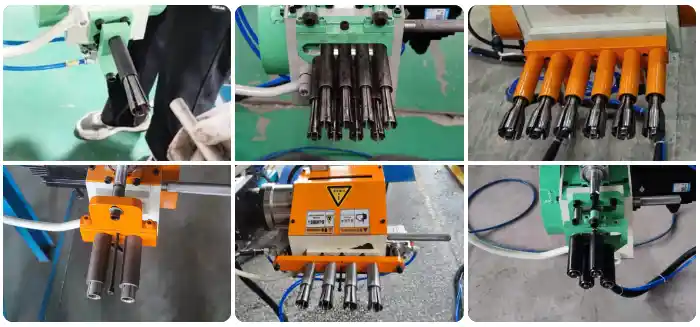
The drive is a servo motor. There is no hydraulic station on the machine. Standard build expands 2, 4, 6 or 8 tubes at a time, takes tube outside diameters from 6 mm to 20 mm, and holds the expanded length to within 0.05–0.1 mm.
How the Copper Tube Expander Works
First, the misunderstanding worth clearing up: the machine does not blow the tube up evenly, the way you would inflate a balloon.
This is what actually happens. The servo motor turns, a 1:10 reduction gearbox brings the speed down and the torque up, and that output pushes a threaded expansion rod forward. A tungsten steel ball sits at the front of the rod, slightly larger than the tube bore. As the ball travels through, the wall is pushed outward from the inside until the outside of the tube meets the wall of the fin hole. Once the ball has passed, the wall springs back a little, and that spring-back is what pins it against the hole.
Three things follow from this.
Why the joint has to be tight. Copper and aluminum are two different metals, and their natural contact always leaves air in between. Expanding is what pushes that air out, so contact resistance drops and the exchanger can reach its design capacity. An exchanger that has not been expande properly simply will not test to the number on the drawing.
What happens when it is expander too far. The wall splits. Or the fin hole deforms and the fin folds over. Either way the whole core goes back for rework, so length accuracy is not a nice-to-have — it sets your scrap rate.
Which is why length control is the core of this machine. The engineer enters the expanded length on the touch screen and the machine holds it to within 0.05–0.1 mm. Tube number 1 and tube number 800 in the same batch come out at the same length. That repeatability is what servo drive buys you over a hydraulic one, and it is the part a tube expanding machine comparison usually leaves out.
What Is Inside the Copper Tube Expander
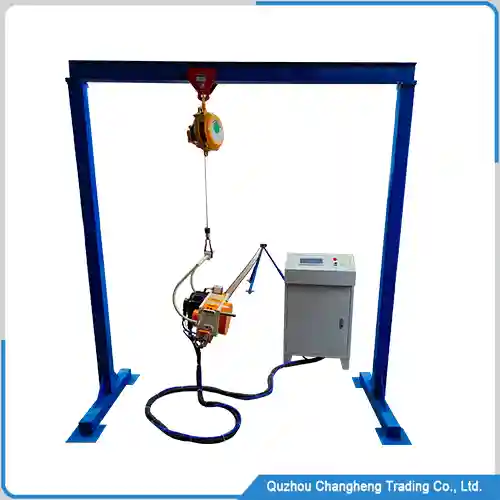
Gantry frame. The skeleton of the machine, and the rail the expansion head travels along, left and right. Frame width is normally 2 m, which has covered every industrial heat exchanger size we have been asked to build for.
Spring balancer. Mounted on the expansion head, it carries the weight of the head. The operator pushes the head along the gantry and it feels almost weightless. That sounds like a small detail, and it is not. Expanding a heat exchanger is one tube after another, and an operator walks the head back and forth several hundred times in a day. Without the balancer the arm is finished by mid-afternoon.
Servo motor and reduction gearbox. The motor is a Delta unit paired with a current-generation drive. The drive controls the angle the motor turns through, and motor angle converts directly into how far the rod travels. That is how the expanded length is held this accurately.
Threaded expansion rod and tungsten steel ball. The thread on the rod is what turns rotation into forward travel. The ball sits at the tip and is the part that actually touches the tube wall. It is made from a high-hardness metal, vacuum quenched, with a smooth surface, because it has to rub its way along the full length of the bore. A softer ball wears out fast.
Touch screen and PLC. A 7-inch screen handles interaction: set the length, switch modes, watch the run. Chinese and English are standard, and other languages can be loaded before the machine leaves the factory.
Copper Tube Expander Machine Technical Parameters
| Parameter | Value |
| Tubes expanded per pass | 2 / 4 / 6 / 8 (custom available) |
| Drive | Servo motor |
| Motor power | 2.2 kW |
| Expansion tube length | 3 m / 6 m / 10 m (optional) |
| Maximum rod length | 10 m |
| Tube outside diameter | 5 – 18 mm |
| Tube wall thickness | 0.25–0.75 mm |
| Length accuracy | 0.05–0.1 mm |
| Expansion speed | 3 m/min |
| Tube materials | Copper, Aluminum, SS304 |
| Power supply | 380 V / 50 Hz |
| Touch screen language | Chinese / English |
| Machine weight | 260 kg |
| Packing case | 220 × 650 × 500 cm |


Tube Materials: What This Machine Expands, and What It Does Not
This part is written plainly on purpose. Better to know now than after the machine lands on your floor.
Copper — home ground for this machine. The copper tubes used in air conditioning, refrigeration and condensers fall inside the standard expansion range, and copper is soft. A 2.2 kW servo motor with the gearbox is enough.
Aluminum and thin-wall stainless steel — also fine. These two are harder than copper, but the wall is thin, so the force needed stays small.
1.5 mm wall stainless steel — you want the 5.5 kW servo-hydraulic version. This is a power problem, not a problem with the machine. Once the stainless wall reaches 1.5 mm, the same expansion ball needs far more force to open the wall, and a 2.2 kW motor cannot deliver it. The servo-hydraulic build is the one specified for that job.
Titanium, and heavy-wall shell-and-tube exchangers — go hydraulic. Those jobs want steady high force rather than speed, which is what a hydraulic power pack is for. Our hydraulic pipe expander machine is the machine for that work. If your volumes are small and the expanding happens at the customer’s site, the portable expander machine travels instead.
Microchannel exchangers are outside the scope of this machine. Those are built by brazing. Brazing and tube expanding are two different routes, and no expander does that job.
Copper Tube Expander Machine working video
Five Advantages
No hydraulic station, so it stays quiet
The machine takes its power from a servo motor and carries no hydraulic station at all. Running noise stays under 51 dB, about the same as a desktop computer fan. With a punch press and a tube bender going in the same bay, this machine disappears into the background.
No hydraulic station also means two things nobody misses: no hydraulic oil to change, and no oil leaks to mark the fins.
It stops drawing power when it stops
The servo motor turns while it is expanding. While the operator loads the core and takes the finished part out, the motor is stopped, and a stopped motor draws no power. A hydraulic machine cannot do this — the pump has to keep turning to hold pressure. Across a shift that comes out roughly 35% cheaper to run than a hydraulic-station machine doing the same work.
Length control of 0.05–0.1 mm
The servo drive controls motor rotation angle, and that angle converts into rod travel. Nothing in that chain compresses, and no valve lags behind the command. The expanded length lands inside 0.05–0.1 mm of the number you set.
Change the ball, change the tube diameter
Moving to a different wall thickness does not need a complicated tool change. You replace the ball at the tip of the rod. That job takes about ten minutes, and the Copper Tube Expander machine does not have to come apart or be recalibrated.
One set of tooling covers several hole patterns
Fin hole layout differs from one customer to the next — tube pitch, number of rows, all of it. We build the machine to your drawing, and the number of tubes it expands in one pass is settled at that stage. Standard designs cover the common sizes. For unusual layouts we build to order, and we do not charge a separate design fee.
Which Heat Exchangers This Machine Fits
Exchanger cores longer than 6 m. Past that length, this class of expander is basically the only option. A vertical or horizontal expander works at a fixed station: the core has to be stood up or laid down inside the machine, and once the tubes get long, the machine footprint and the building height run out. Here the core stays put and the head travels, so length stops being a limit. Our rods go up to 10 m.
Shell-and-tube exchangers with thin-wall stainless or titanium tubes. These need more force than copper, and the bench machines do not have it. Check the material boundaries above first — heavy wall tube still belongs on the hydraulic machine.
Small exchangers: this machine does them, but a dedicated machine does them faster. Straight answer — if your cores are one or two metres long and you run high volumes, a vertical machine will beat this one on cycle time. The usual reason buyers pick this machine instead is price and flexibility: one machine covers several different sizes. Plenty of shops building small exchangers run it as their main expander.
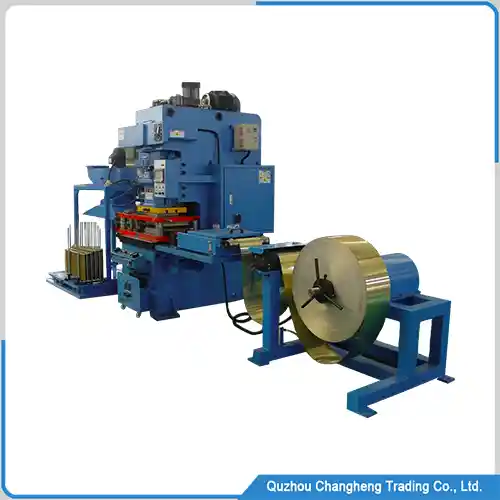
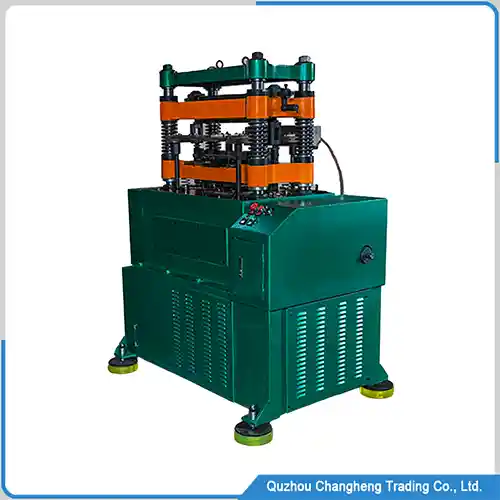
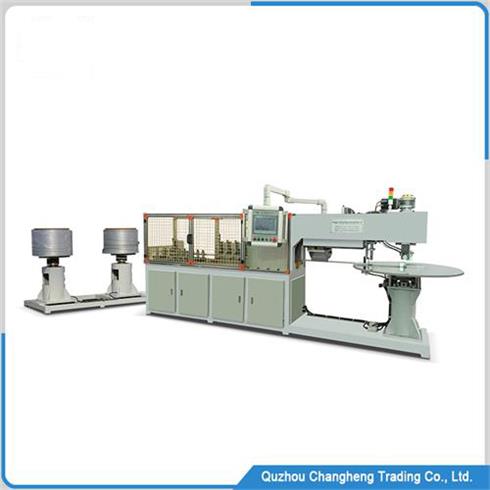
Punching, finning, expanding and cutting are one process chain. This page covers the expanding station. The stations on either side:
- copper fin machine — forms the fin strip
- copper tube punching machine — punches the fin holes
- coil tube straightening machine — straightens and cuts the tube
- heat exchanger tube expander — the fixed-station version of this work
The full equipment list for the line is on our aluminum heat exchanger machine list.
How to Choose the Right Copper Tube Expander
You do not have to work through the parameter table on your own. Send us these six items and our engineers come back with a model and a price:
- Tube material — copper, aluminum, stainless steel, or titanium?
- Tube outside diameter — Φ7, Φ9.52, Φ12, for example. List every size you run.
- Tube wall thickness — this is what decides whether you need the 5.5 kW servo-hydraulic build.
- Longest core — give us the longest one, because it sets the rod length and the floor space you have to reserve.
- Fin hole layout — tube pitch and number of rows. A drawing is fastest if you have one.
- Tubes per pass — 2, 4, 6, 8, or more.
One more thing: mains voltage differs by country. Tell us the voltage and frequency at your site when you order.
Installation, First Run and Daily Care
These notes come out of machines already delivered. Reading them before installation saves a day.
The first power-up shows a warning on the touch screen. This is normal. The servo motor and the control system ship in separate packaging, so the motor’s origin data is empty when the machine is assembled. It needs to be set once. A manual and a video come with the machine; follow the video and it is done. It only has to be done once.
Leave enough room in front of the Copper Tube Expander machine. The rod travels the full length of the core, so the clear space in front has to be longer than the core itself. Rule of thumb: a 5 m core needs about 11 m of clear floor.
Cut the power before changing the rod. This is a safety rule, not a suggestion. While the rod is being changed, the operator’s hands are inside the machine’s travel. If someone brushes the start button, the machine moves. Power off first.
The expansion ball is a consumable — keep a few. It rubs against the tube wall the whole way through, so wear is normal. Once it has worn past a certain point the expanded size stops being stable, and the fix is a new ball. They cost very little, which is exactly why we designed the ball to be replaceable.
Check the threaded section of the rod on a schedule. The thread is where the force is transmitted, and it wears over time.
Q & A
A: Standard builds take 2, 4, 6 or 8. We also build more, matched to your fin hole layout. More tubes per pass means a larger machine and more demands on the operator, so more is not automatically better — pick the count that matches your cycle time.
A: 0.05–0.1 mm.
A: Yes. Order the matching expansion ball and the right rod length. Stainless is harder than copper, so the expansion speed is run slower.
A: That job moves to the 5.5 kW servo-hydraulic version. Once the wall thickness is up, opening the tube takes much more force, and a 2.2 kW motor cannot drive it.
A: Yes. Standard and optional rod lengths are in the parameter table above. The long rods are built to order, and you need the floor space in front to match. The longer the tube, the more the stiffness of the rod matters, so give us the exact core length when you enquire.
A: Changing the ball at the tip of the rod takes about ten minutes. Changing the whole rod takes longer.
A: Yes. Chinese and English are standard. Russian, Spanish, Portuguese, French and Arabic can be loaded before shipment at no extra charge.


 wechat


